
Camping
Planning a caravan holiday: route, pitch, driving time
Towing means different numbers: speed limits, driving times, finding a pitch. How to plan a caravan route that still works out on day three.
Published Reading time 9 min Updated
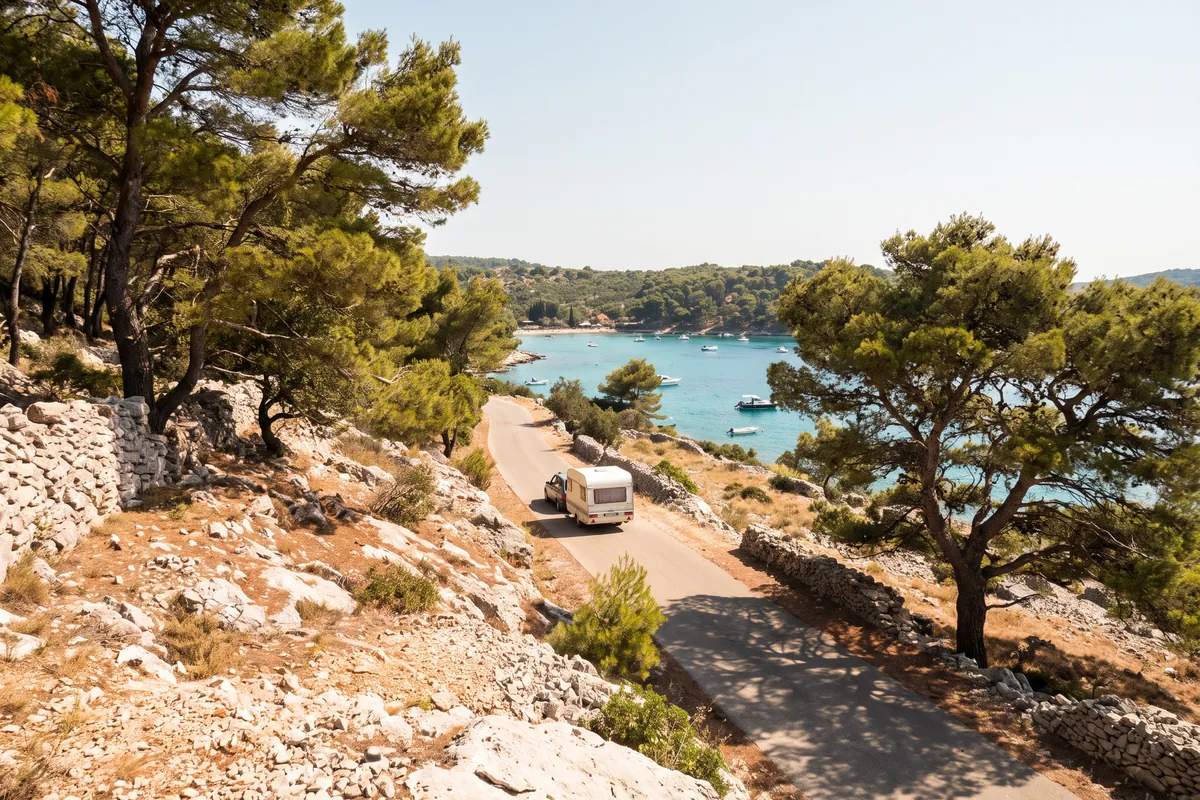
Travelling with a caravan changes the planning in a single place — and that one place then changes everything else: the driving time is no longer right.
Every route tool calculates for a car by default. When towing, the number shown there is systematically too low, and not by ten per cent but often by half. Anyone who takes it anyway is planning a trip that stops working on day three.
The driving time is a different one — and that shifts everything
Four items add up: the speed limits for trailers (in Germany usually 80 km/h, more with a 100 km/h approval, and varying by country abroad), the gradients, where it is not the limit that slows you but the engine, the more frequent breaks — and the setting up and packing down at the destination, which comes with every change of site, no matter how far you drove.
As a rule of thumb for rough planning: car driving time × 1.5, plus one hour for arrival and setting up.
The individual items, a fully worked example and a way to check it against your last trip are under Working out a realistic driving time with a caravan.
If the tool calculates the driving time for the vehicle entered anyway, you save yourself the surcharge — the right number then sits on the leg, and nobody has to convert in their head.
Fewer changes of site than you think
From the setting-up item follows the most important rule of caravan planning: every change of site costs half a day.
That produces a different rhythm than a hotel tour:
- At least two nights per site. One night means: set up, sleep, pack down. That is not an overnight stay, that is a move.
- Three to four nights is the comfortable measure. A day to arrive, one or two days for the area, a day to move on.
- For three weeks, prefer four sites to eight. The time you do not spend manoeuvring is the time you drove there for.
Anyone who sees the route as a map rather than a list notices quickly whether the legs are in a sensible proportion — or whether between site three and four there is a stretch that eats the day.
Look for the pitch before the route is settled
On a hotel holiday you look for the destination first and the accommodation second. With camping it is the other way round: the site is the destination. It is named after the bay it sits on, and the bay is the reason you are going.
What counts in the choice and appears in no review:
- Pitch size and access. A lovely site with an approach too narrow for your outfit is not a site. Take the stated "max. outfit length" seriously.
- Ground and slope. Grass sounds good and is a problem after three days of rain. A slope costs levelling ramps and patience.
- Services. Fresh and waste water, electricity (amps!), disposal. The amperage decides whether the air conditioning and the kettle can run at once.
- Season. Many of the finest sites on the Mediterranean open only at the end of April and close at the beginning of October. A site closed during your travel period is the classic case for a "check" note rather than a silent assumption.
Reserve the high-season sites early and the low-season sites not at all. Arriving on the Adriatic in July or August without a reservation is a risk; in May the freedom to stay on a whim is worth more than the booking.
What comes with several vehicles
When two or three outfits travel together, the problems do not double, but the coordination becomes a job of its own:
- The slowest combination sets the pace. A motorhome with 140 hp and an outfit with a small diesel are two different trips on a climb.
- Sites need several free pitches next to each other — this has to be stated explicitly when reserving and is often forgotten.
- Everyone needs the route, not just the destination address. You lose each other on the road, and with a caravan you do not simply turn round.
That is why it is worth having everyone see the same plan: which sites are booked, which are only an idea, where a night is still open. How that works in a group without chat chaos is covered in Planning a holiday with friends.
A caravan route in seven steps
- Match the travel period against opening times. First check whether the area is open at all during your period.
- Settle on two to four locations, no more. Better to stay longer.
- Plan the journey there as its own leg. For many it is the longest driving day of the whole holiday, and it is usually underestimated.
- Calculate driving times for towing, not with car figures — plus one hour of arrival per change of site.
- Plan intermediate stops when a leg runs over five hours. A stopover site is cheaper than an argument.
- Check the sites and enter them, with a status: booked, idea, or "check" if something is still open (length, season, dog).
- Leave the open nights visible. What nobody has entered belongs in the plan as a gap, not in the hope that it will sort itself out.
What counts in the end
You do not recognise a well-planned caravan holiday by everything being booked. You recognise it by not having to do arithmetic on day three — because the numbers in the plan were already the right ones.
Anyone who would rather stand somewhere different every night than at one site will find the system for that in Planning a motorcycle tour: there every night is a leg of its own, and that is exactly the difference.