
Motorcycle
Planning a motorcycle tour: legs, distance, overnight stays
A motorcycle tour is a sequence of legs, not a location. How to settle daily distance, overnight stays and breaks — including when several bikes are riding.
Published Reading time 9 min Updated
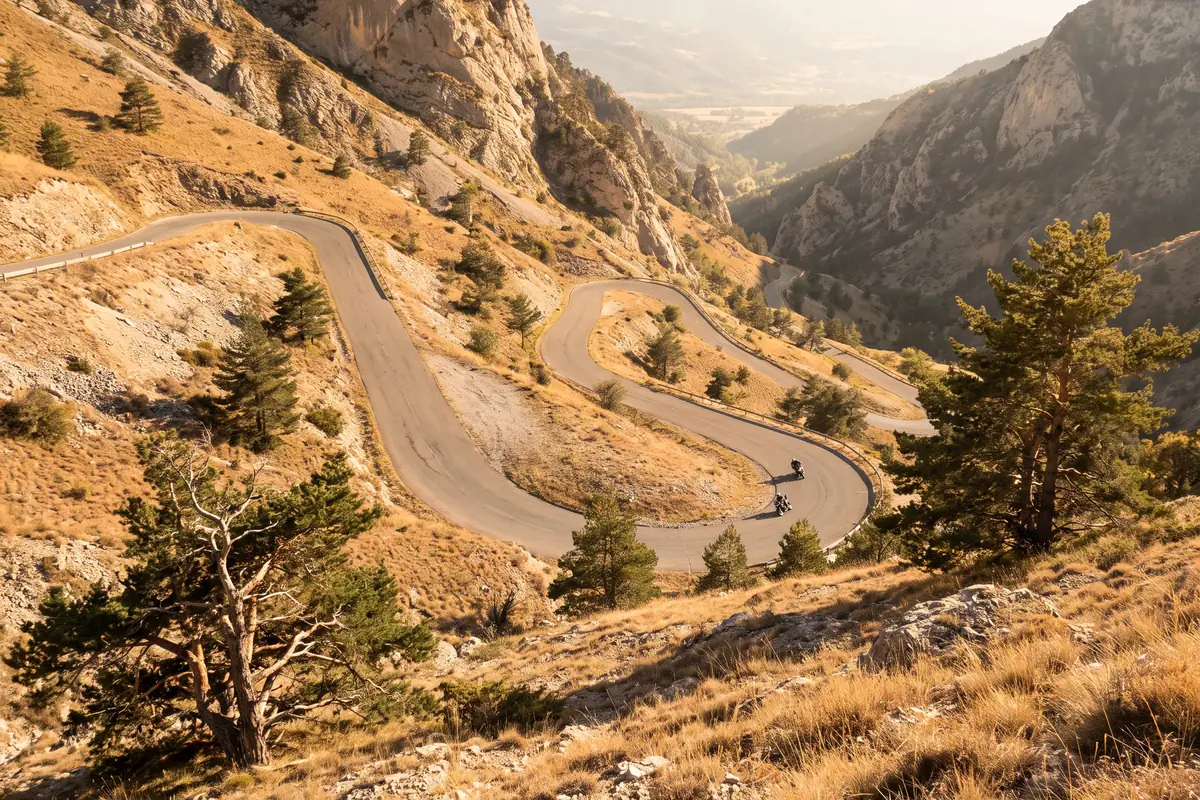
On a motorcycle tour the road is not the way to the holiday. It is the holiday. That sounds like a platitude and has a very concrete consequence for planning: there is no base to make day trips from. Every night is in a different place, and each of those places has to fit the one before it and the one after it.
That makes a motorcycle tour a plan made not of places but of legs — and a leg is something other than an address.
The leg is the unit, not the place
A hotel holiday has a centre. A tour has an order. The difference affects everything:
- A place in the middle of the tour is only as good as both the roads that hang off it. A wonderful hotel in the wrong spot ruins two days, not one.
- The order is itself information. "Leg 02 of 6" says more than a date, because it answers where you stand in the sequence.
- A change in the middle shifts everything after it. Rebook the third night and you have touched four more.
Anyone who plans a tour as a list of hotels notices this the first time they ride the list.
Daily distance: the number everyone overestimates
The most widespread planning error is the daily distance, and it always comes about the same way: you calculate at motorway speed and then ride country roads with bends — which is exactly what you set off for.
Two numbers are enough as a starting point for the rough division: 300 to 400 kilometres on winding country roads, 150 to 250 over passes. Three passes are a full day.
Anyone who needs it more precisely — the calculation in hours rather than kilometres, the effect of heat and fatigue, what group size costs, and how to derive your own number from your last tour — will find it under How many kilometres a day on a motorcycle?.
One correction belongs in the rough planning, though: cut the first day by a third. Getting there, packing, the first fuel stop, the first break, until the group has found its rhythm. The first day is never a normal day.
Riding in a group means planning slower
A group does not ride as fast as its fastest member, nor as fast as its slowest. It rides as fast as its slowest member plus the effort of staying together — and that costs noticeable time.
What that means for planning:
- Agree meeting points, not convoys. Anyone who relies on keeping the group in the mirror is no longer riding the road but the mirror. One agreed meeting point per leg takes the pressure out.
- Ask about the machines before you book. An adventure bike and a tourer can take the same leg; a 125 scooter in the same group changes every day's plan.
- Establish the smallest fuel range before you cut the legs. It determines where the group has to stop — not the largest.
Breaks are stations, not marginal notes
A viewpoint where you stand for an hour belongs in the plan like an overnight stay. And not as a remark under the leg, but as its own station with its own point on the map.
The reason is practical: a stop that exists only as a note is the first thing dropped under time pressure — and that is usually the very stop somebody suggested the route for. A stop that sits between two places in the leg it belongs to shifts the arrival time visibly. Then the decision is made deliberately.
Three kinds of stop that belong in every day's plan:
- The fuel stop. By the smallest range in the group, not by your own.
- The sight stop. The pass, the lake, the castle. The reason for the route.
- The food stop. The most frequently forgotten one. In the mountains there is often nothing at all for forty kilometres between two villages.
What is open belongs visibly in the plan
On a tour there is one error that is particularly expensive: a night nobody has booked anything for, without anyone noticing. With a base that can hardly happen — there is one booking for everything. With six nights in six places it happens regularly.
That is why it matters that a gap in the plan looks like a gap: the connection nobody has entered lies as a dashed straight line between two places — without a distance and without a time, because neither exists yet. It disappears only when somebody enters it.
The same goes for the onward journey after the last planned leg. "We'll see when we get there" is a legitimate decision — but it should be in the plan and not in one person's head.
Building a tour in eight steps
- The timeframe and the ride home first. When do you have to be back? The ride home is a leg like any other and is nevertheless almost never planned.
- Set the two or three fixed points. The pass you want to ride. The coast you want to stay at for a day. More fixed points turn the tour into an appointment.
- Divide the days roughly — with the numbers above, not with optimism.
- Look for places to stay that lie on the line. A place 40 km off it costs 80 km, not 40.
- Number the legs. From here the tour has an order, and every change is a visible change.
- Enter breaks as stations, in the leg they belong to.
- Name the gaps. Every night without a booking, every stretch without a connection.
- Only then book — from the back forwards, so the ride home is not whatever happened to be left.
The plan belongs to everyone riding along
Even on a tour of three it is worth having everyone see the same plan — with the legs in their order, the statuses and what is still open. Not because everyone wants to plan, but because on the road everyone has to know where today's destination is if the group gets separated.
How collecting suggestions in a group works without everything disappearing into chats is covered in Planning a holiday with friends. And anyone who would rather have a base than legs will find the counterpart under Planning a hotel holiday.