
Motorcycle
How many kilometres a day on a motorcycle?
300 to 400 kilometres is a good day on country roads, over passes more like 200. Why the number belongs calculated in hours — and what it costs in a group.
Published Reading time 7 min Updated
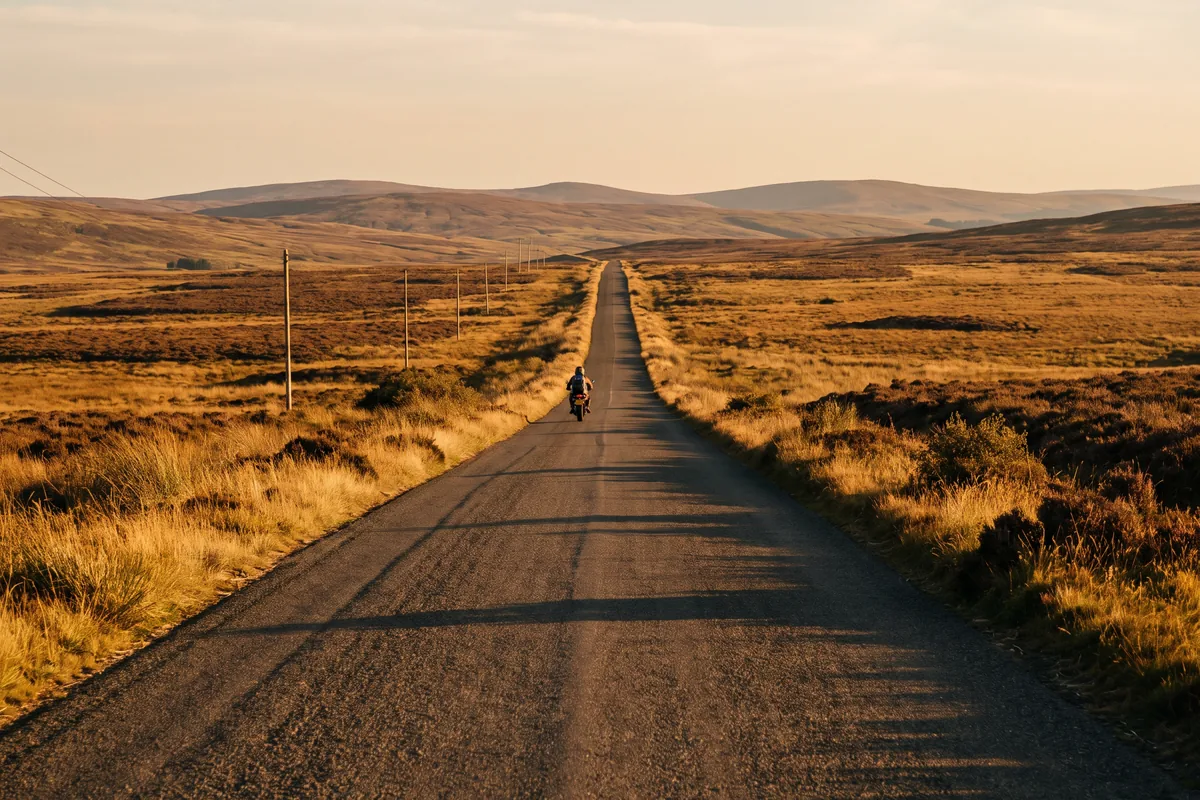
The short answer: 300 to 400 kilometres is a comfortable day on winding country roads. Over passes, more like 150 to 250. On the motorway you can manage 600, but then you have seen motorway.
The longer answer is more interesting, because the number of kilometres is the wrong measure. It is only customary because it is easy to write down.
Count in hours, not in kilometres
A day does not have 400 kilometres, it has hours. And the number that really counts is the time in the saddle — everything else follows from it.
Six hours of riding is the upper limit of a day for most people if you still want something of the place in the evening. What that comes to in kilometres depends entirely on the average:
| Kind of road | realistic average | 6 hours give |
|---|---|---|
| Motorway, pure transit | 100–110 km/h | 600–660 km |
| Main and country roads, flat | 65–75 km/h | 390–450 km |
| Winding country roads, hilly | 50–60 km/h | 300–360 km |
| Passes, hairpins | 35–45 km/h | 210–270 km |
| Narrow mountain roads, gravel | 20–30 km/h | 120–180 km |
These averages are travelling averages, not riding speeds. They already contain what happens between two bends: going through villages, a tractor, roadworks, the traffic light. Anyone who calculates with their preferred speed reliably arrives late.
The use of this calculation shows itself on the first mixed day: 120 km of motorway plus two passes plus 80 km of country road is not "350 km, that'll be fine", but 1.2 + 2.5 + 1.4 = a good five hours — and therefore a full day, although the distance looks harmless.
Fatigue is the real limit
On a motorcycle the scarce resource is not fuel but concentration. And it does not fall off linearly, it tips.
A rough but surprisingly dependable progression:
- Hours 1 to 3 — the good hours. This is when you ride best and get the most out of it.
- Hours 4 to 6 — workable, if there are enough breaks in between.
- From hour 7 — the mistakes come. You brake later, look less far ahead, run the bend wider. And you are the last to notice.
On top of that come factors that act more strongly than most people allow for: heat above 30 degrees quickly costs one to two hours of capacity, rain likewise, crosswind on the motorway is genuinely tiring after two hours. And a day of headwind at 14 degrees in drizzle is not a 400-kilometre day, whatever the plan says.
What the group costs
Alone you ride the plan. With five of you, you ride the plan plus the effort of staying together — and that is greater than it feels.
Allow about ten more minutes per stop for each additional machine. Not because anyone is dawdling, but because a stop with five machines does not run five times in parallel but one after another: fuel, helmet off, drink, everyone ready again. With four stops a day and five machines that is around an hour nobody planned for — and therefore 50 to 60 kilometres less.
Two further group effects:
- The smallest range sets the fuel rhythm. A machine with 14 litres forces the whole group to the pump every 200 kilometres, even if three others manage 350.
- The slowest rider sets the average — and rightly so. A group riding at the limit of its weakest member is not riding fast, it is riding at risk.
The first and last days count half
Two days of every tour never work like the others, and both are regularly planned in full.
The day out. Packing, setting off, the first break, until the group has found its rhythm — and usually it does not start at eight but at half past ten. Cut it by a third.
The day home. It is almost never planned, because it does not feel like holiday. Which is exactly why it becomes the longest, the least pleasant and the one with the deadline — and a deadline on a motorcycle is the worst ingredient of all.
Finding your own number
The table above is a starting value, not a truth about you. The most honest route to your own number goes through your last tour:
- Take a day that felt good — not the longest one.
- Work out the pure riding time, without breaks.
- Divide the kilometres by those hours. That is your travelling average.
- Multiply it by the hours you actually want to ride.
Do that twice and you have a number that is right for your own group — and for most people it lies noticeably below what they would have planned before.
And then it belongs in the plan
A daily distance is of little use as long as it sits in one person's head. Once the legs are numbered and each one carries the calculated driving time — for the vehicle that is actually riding — everyone in the group can see whether day 3 is a pleasure or a slog. And see it before it is booked.
How a tour is built overall — fixed points, overnight stays, breaks as stations of their own, and the gaps that should stay visible — is covered in Planning a motorcycle tour. For outfits with a caravan, entirely different numbers apply; those are under Working out a realistic driving time with a caravan.